

Tankless vs Tank Water Heater
Quick answer
A conventional tank water heater can be the practical choice when you want a lower-cost replacement and your current setup meets your needs. Tankless may be worth considering when back-to-back hot-water use or space is a problem, but the conversion can involve more than changing the heater. Start with your home’s utilities, busiest hot-water period, water quality, and maintenance needs. If the existing heater has a repairable problem, compare that option before committing to replacement.
For Carrollton and North Dallas homeowners, the better choice depends on what is actually causing the problem. Running out during consecutive showers, waiting for hot water at a distant bathroom, and having a failing heater are three different issues. A new tankless unit does not automatically solve all three.
What changes the installed cost
A straightforward replacement of a conventional tank is generally less involved than converting that location to tankless. The useful comparison is the complete installation scope, not the price of two appliances on a shelf. A conversion may require changes to the gas supply, venting, electrical connection, water piping, or condensate drainage, depending on the selected heater.
| What to compare | Conventional tank | Tankless |
|---|---|---|
| Installation | Existing connections may simplify replacement. Required corrections still count. | Conversion work can add to the equipment cost. |
| Hot-water capacity | Stored supply and recovery determine how long it keeps up. | Output depends on simultaneous flow and temperature rise. |
| Space | Floor area plus clearance and service access. | Smaller appliance, with mounting, connections, and service space still needed. |
| Maintenance | Model-specific inspection and sediment control. | Model-specific inspection, filter care, and scale control. |
| Best question | Does the available supply meet our busiest hour? | Can it serve the fixtures we use at the same time? |
This comparison covers conventional gas or electric resistance tanks. Heat-pump water heaters also use storage tanks and deserve a separate comparison, especially in an all-electric home.
Ask for a quote that explains the work
For either option, ask what the estimate includes: equipment, removal of the old unit, connection changes, required safety components, permits, and inspection arrangements. Then ask which items change if you choose the other option. This makes the difference in price easier to judge.
Ask for the proposed model and its maintenance requirements in writing, along with the work included in the estimate. If two proposals differ, find out whether they cover the same installation scope. A lower equipment price does not tell you whether removal, connection changes, or required corrections are included. Likewise, a longer warranty should be read for its actual coverage rather than treated as a promise that every future repair will be free.
Plumbing Dynamics provides free estimates based on an on-site assessment. A technician checks the actual installation before giving you pricing. That is more useful than a phone estimate built around assumptions about your gas line, access, or existing connections.
See our water heater replacement and installation service for help evaluating your existing setup.
Lifespan matters but age is not a diagnosis
Lifespan estimates are planning guides, not expiration dates. UF/IFAS Extension cites a general 10-to-15-year range for water heaters. Rinnai describes a useful life of up to 20 years for its tankless units, depending on water quality, use, and maintenance. Neither estimate promises how long a particular heater will last.
Before replacing an older unit, identify the problem and compare repair cost, condition, parts availability, and how well it meets your needs. A repairable component problem is different from a leaking storage vessel. Ask the technician to explain the finding that supports the recommendation.
Hard water makes maintenance part of the decision
Water hardness comes largely from dissolved calcium and magnesium. Heating hard water can leave mineral scale on surfaces inside the system. The USGS guide to water hardness explains how buildup can restrict passages and affect equipment performance. Check your utility’s current information or test the water at your home instead of assuming one hardness level applies across North Texas.
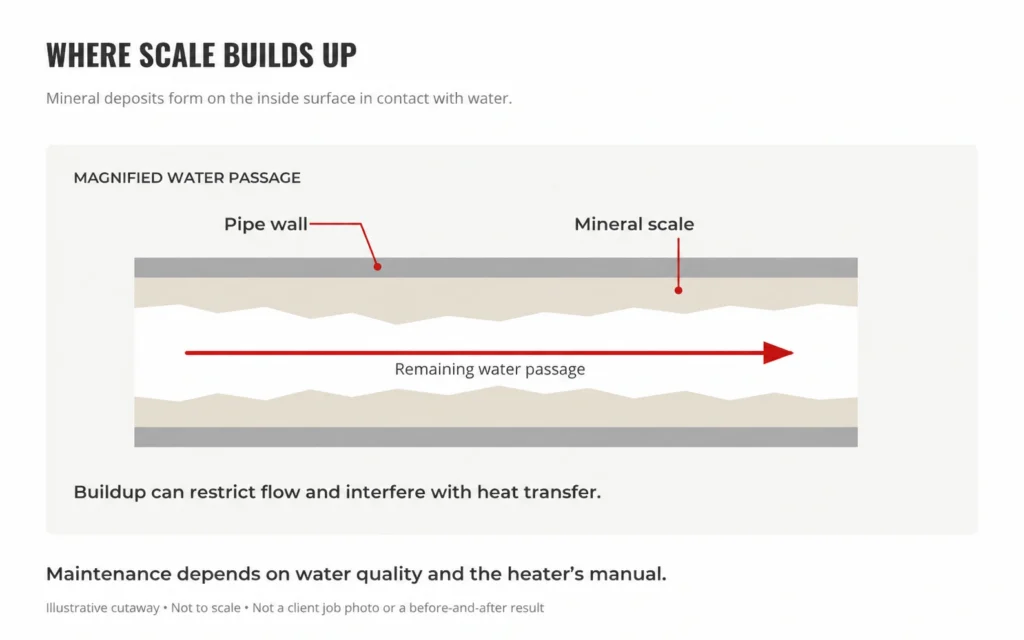
Scale forms on surfaces in contact with water. This enlarged cutaway explains the mechanism; it is not a client job photo, a measured blockage, or a before-and-after result.
Both heater types need maintenance. Follow the specific manual and account for water quality and use. Tankless service can include inlet-filter care and flushing to address scale; it is not simply the same task as draining a storage tank. Ask what service your model needs and how often.
Plumbing Dynamics’ VIP maintenance benefits include a water-heater flush and a full-house inspection. Confirm how the plan applies to your specific heater, including any tankless descaling work, before treating it as part of your ownership-cost comparison.
Will tankless lower the energy bill
Tankless avoids keeping a large reserve of water hot between uses, but that does not establish a guaranteed dollar saving for your home. Fuel prices, the models being compared, hot-water use, and maintenance all affect the result. A longer shower schedule can also change the calculation.
Compare the specific models’ EnergyGuide estimates and efficiency ratings, then check the assumptions against your own utility rates and habits. Uniform Energy Factor, or UEF, is an efficiency measure, not a forecast of your monthly bill. Include installation and ongoing service costs when deciding whether the upgrade is worthwhile.
For an all-electric home, include a heat-pump water heater in the discussion. It heats stored water by moving heat from the surrounding air. ENERGY STAR’s guide to heat-pump water heaters explains this option. The tank-versus-tankless label alone does not tell you which system will use less energy in your situation.
Space utilities and North Texas weather
A smaller appliance does not mean it fits anywhere. The installation must allow access for service and meet the selected model’s requirements. For gas tankless, the assessment should cover gas capacity, the approved venting arrangement, electrical power, and condensate disposal where applicable. Electric tankless requires an electrical-capacity assessment.
Freezing weather deserves attention, especially for outdoor equipment and exposed piping. Built-in freeze protection has limits and may depend on power. It does not automatically protect the pipes outside the heater. Have the installation and outage plan checked against the manufacturer’s instructions.
Carrollton requires a permit for water-heater installation. Confirm the permit and inspection process for your city as part of the estimate, including who handles each step.
Choose around the problem you want to solve
Start by describing a normal busy morning: which showers overlap, whether laundry is running, and when the hot water falls short. For a tank, ask about the first-hour rating, which accounts for the hot water available during a busy hour. For tankless, ask about output at the temperature rise your home needs, not just the largest flow number in an advertisement.
Tankless can support consecutive uses without waiting for a storage tank to recover, but simultaneous demand still has to fit its capacity. If the complaint is a long wait at a distant faucet, discuss the piping layout and delivery options separately. Changing heater type alone does not remove the cooled water already sitting in the line.
Explore our tankless water heater service and compare the installation scope with a tank replacement before deciding.
Questions to work through before you choose
You do not need to choose a heater before the technician arrives. Bring a clear description of the problem and ask for a comparison that reflects your home. These questions help turn a general tank-versus-tankless discussion into a decision you can evaluate.
What happens during our busiest period?
Think about overlap, not just the number of people who live in the house. Two showers running together create a different demand from two showers taken one after the other. Add any other hot-water use that commonly happens at the same time, such as laundry or dishwashing. Ask the installer to show how the proposed heater matches that pattern and what changes if another fixture is used.
Which parts of the existing setup can stay?
Ask the technician to separate required work from optional improvements. Which connections can be reused? Which changes are necessary for the selected model? Would moving the heater solve a specific problem, or simply add work? If an estimate includes a utility upgrade, ask what assessment supports it. The explanation should make the installation price understandable without requiring you to become a plumbing expert.
What will ownership involve after installation?
Request a practical maintenance plan for the exact model. Find out what should be inspected, what service is recommended for your water conditions, and which tasks call for a professional. Keep the model number, installation paperwork, and service records together. Before counting a maintenance membership toward future costs, confirm which work is included and which services would be quoted separately.
Would a repair address the actual complaint?
Ask what the diagnosis shows before weighing replacement options. If the heater previously kept up and the problem is new, have that change investigated. If the household has grown or the pattern of use has changed, explain that too. A useful recommendation should connect the finding to the proposed solution, then explain the tradeoffs of repairing the current heater, replacing it with a tank, or converting to tankless.
What would make us choose the other option?
Ask for the strongest reason to choose each suitable option. For your home, that might be a simpler installation, a better fit for consecutive showers, or a different use of space. Then ask what you would give up. You should leave the conversation understanding both the benefit and the limitation of the option you select.
Frequently asked questions
What is the main difference between tank and tankless water heaters?
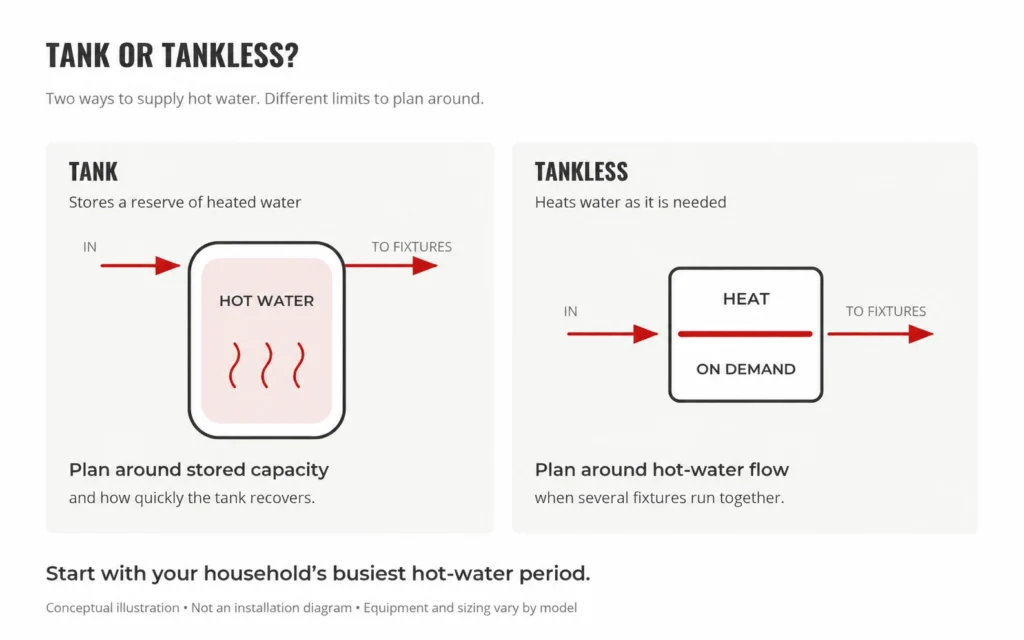
A tank stores heated water and reheats it as needed. A tankless unit heats water on demand without a large storage reserve. One relies on stored capacity and recovery; the other must keep up with the required hot-water flow.
Does tankless mean instant hot water at every faucet?
No. Hot water still has to travel through the piping. A distant faucet can take time to warm up with either type. If waiting is the problem, ask about the delivery system as well as the heater.
Can a tankless water heater work with hard water?
Yes, when the installation, water quality, and maintenance meet the manufacturer’s requirements. Discuss scale control and a service schedule for the specific unit. Hardness should be checked for your home, not assumed from a regional average.
Is gas or electric tankless better?
The answer depends on available utilities and the hot-water demand. Gas units need an appropriate gas supply and installation arrangement. Electric units need sufficient electrical capacity. Compare complete installation proposals for suitable models.
How long does water-heater installation take?
Timing depends on access, equipment availability, connection changes, and the local permit and inspection process. Ask for a schedule after the on-site assessment. A tankless conversion can involve additional work beyond a straightforward replacement.
Will tankless save money for a family of four?
Household size alone cannot answer that. Compare the installed price, expected energy use at your rates, maintenance, and your actual pattern of use. A lower operating cost does not automatically make up for a higher installation cost.
Do I need a permit in Carrollton?
Yes. The City of Carrollton states that a permit is required for all water-heater installations. Confirm the current process and inspection arrangements when planning the job. Other municipalities have their own requirements.
Should I replace a heater just because it is more than eight years old?
No. Age is one part of the assessment. Have the fault diagnosed, then compare repair and replacement based on condition, repair cost, parts availability, and whether the heater still meets your needs.
Find the right water heater for your home
The right water heater should fit your busiest morning, your home’s existing utilities, and the costs you are comfortable taking on over time. A conventional tank may offer a simpler replacement when the current setup meets your needs. Tankless may be worth the additional installation work when consecutive hot-water use or limited space is the priority. Neither choice should be made on equipment price, an advertised lifespan, or an energy-saving claim alone.
Compare the full installation scope, realistic hot-water capacity, and ongoing maintenance before deciding. North Texas homeowners should also account for their water quality and the freeze-protection needs of the installation. If your main complaint is a long wait at the faucet, make sure the assessment addresses hot-water delivery. If the existing heater has a repairable fault, find out whether a repair can solve the problem first.
Have you been thinking about a new water heater?
Plumbing Dynamics is a family-owned, woman-owned company with non-commissioned technicians. Learn more about our team and approach. Our recommendation starts with an honest diagnosis and whether a sensible repair can address the problem. If replacement is the better option, we will explain the work and pricing after evaluating the installation.
Tell us what is happening now: running out during showers, inconsistent temperatures, a new problem with an older unit, or planning ahead for replacement. We can assess the existing setup and explain suitable options so you can make an informed decision.
Call 214-929-3431 or request a free estimate to compare options for your home.